


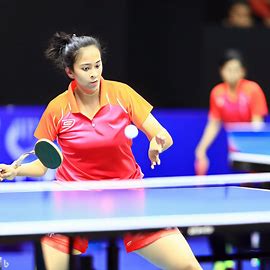
If you play table tennis long enough, you eventually notice something unsettling. The players who seem to have endless time are not always the quickest movers or the youngest bodies in the room. They are often calmer, quieter, almost relaxed, while your own hands feel like they are rushing to survive every rally. You already know speed matters. The real issue is what kind of speed actually wins.
Here is the thing. Table tennis is not a game of fast hands. It is a game of fast subconscious decisions. By the time your conscious mind tries to keep up, the ball has already bounced twice. When players talk about reaction time, what they usually mean is something deeper and far more powerful. It is the ability to recognize patterns before you realize you are doing it.
The best table tennis players do not react faster. They recognize earlier.
This article is not about drills or footwork plans. It is about why the subconscious mind decides outcomes long before your hands ever move, and how understanding that changes the way you train, compete, and trust yourself under speed.
Not because you lack coordination, but because your conscious mind is trying to drive a sport that moves too fast for conscious thought, many players experience that familiar tightness. The harder the rally, the more effort they apply. The more effort they apply, the worse their timing becomes. Not X but Y. Not slow reflexes, but conscious interference.
You already know what it feels like. A fast serve comes in, your eyes lock onto the ball, your body stiffens, and suddenly your arm feels disconnected from your intention. This does not happen because you forgot how to hit a forehand. It happens because fear of error pulls control upward into conscious thought.
Table tennis exposes this problem faster than almost any other sport. The ball travels too quickly, the margins are too fine, and the rallies rarely allow time for decision making. When players try to consciously steer each movement, the nervous system goes into protection rather than execution.
Here is the subtle shift. The goal is not to speed yourself up. The goal is to get out of the way of what already knows what to do.
The subconscious mind works on simulation, not calculation. It does not analyze spin types in words or angles in equations. It absorbs thousands of repetitions and forms instinctive predictions. When a serve is tossed, your subconscious is already estimating trajectory, speed, and intent before contact even happens.
This is why elite players often say they knew where the ball was going as soon as their opponent moved. That knowledge did not come from analysis. It came from stored patterns firing automatically. Not because they thought faster, but because they did not think at all.
The subconscious does not wait for instructions. It executes what it has practiced trusting.
When players struggle, it is rarely a lack of knowledge. You already know how to block, loop, push, and counter. The real issue is whether your subconscious feels safe enough to run those programs at speed without being micromanaged.
Confidence in table tennis is not bravado. It is permission. Permission for the body to act without commentary, correction, or fear.
Pressure changes nothing mechanically. It changes where authority lives. Under stress, many players pull control upward, trying to force precision through conscious effort. This is not because pressure is intense, but because the subconscious associates pressure with danger.
When the nervous system detects threat, fine motor control tightens. Movements become rigid. Timing collapses. The irony is that the harder you try to place the ball perfectly, the less control you actually have.
This is why players can dominate in practice and freeze in competition. Practice feels safe, so the subconscious stays online. Matches feel evaluative, so the conscious mind steps in, believing it must protect the outcome.
The solution is not more motivation. It is training your subconscious that competition is not a threat requiring intervention.
Here is where most training goes wrong. Players repeat techniques without addressing the mental state that allows those techniques to appear under speed. Repetition alone does not guarantee trust. Trust is built when the subconscious experiences success without interference.
This means slower drills done with full intention, rhythm, and relaxation often transfer better than frantic high speed rallies filled with tension. Not because slow is better, but because calm embeds pattern clarity.
Your subconscious learns best when accuracy and ease coexist.
Mental training, especially visualization and subconscious rehearsal, plays a critical role here. When you mentally experience reading spin early, moving early, and striking freely, your nervous system begins to accept that speed does not require panic.
You are not trying to control the shot. You are teaching your system that it already knows how.
At higher levels, table tennis becomes a perceptual game. Seeing subtle cues earlier creates the illusion of time. Opponent posture, racket angle, breathing rhythm, and movement habits all feed the subconscious instant data.
This is why experienced players seem unhurried. They are not faster physically. They are earlier psychologically. Their subconscious commits before others are still deciding.
Training perception means slowing your internal state, not rushing drills. It means learning to feel cues rather than chase outcomes. The calmer your internal rhythm, the sooner your subconscious notices what matters.
Speed emerges naturally when hesitation disappears.
Table tennis rewards players who trust what happens below the surface. The fastest hands in the world are useless if they arrive without timing, flow, and permission. You already know how to hit the ball. The real work is not physical improvement, but subconscious alignment.
When you stop trying to outpace the game and start syncing with it, rallies feel slower, reactions feel lighter, and mistakes lose their emotional weight. Not because you became faster, but because the system underneath you finally had room to operate.
Speed is not something you add. It is something you stop blocking.
That is why table tennis does not reward the fastest hands. It rewards the fastest subconscious.

🔒 Related Products
All our programs use theta brainwave frequencies and binaural beats to guide your mind into the deeply receptive state where subconscious change actually occurs - the same state reached by experienced meditators, and the level at which hypnotic suggestion produces its most lasting results. Simply listen with headphones, relax, and let the recordings do the work.
🧠 Most Specific Product
The Table Tennis Visualization Hypnosis Program works directly at the deepest subconscious level to bring about improvements in all areas of performance.
The Freedom from Anxiety Program dissolves stress, worry and overwhelm at the deepest subconscious level with a powerful 4-track hypnosis system.
The Deep Focus & Concentration Program is a 5-track subconscious system designed to build deep work states, concentration, and sustained mental clarity for high-performance focus.
🎯 Need Something More Personalized?
While our pre-made programs are effective for most people, sometimes you need something tailored specifically to your unique situation. Our Custom Hypnosis Recordings are personally designed for you, giving you the flexibility to target your specific goals and challenges through carefully engineered layered audio tracks, theta brainwave entrainment, binaural beats, and NeuroFrequency Programming™ - to guide the mind into deeply relaxed, highly receptive states where positive subconscious changes occur more naturally.
🎯 New to Relaxation / Self-Hypnosis?
Our complementary 12 Minute Relaxation provides a guided recording perfect for starting out, or for anyone wanting quick light relaxation. More free downloads also on this page, for sleep etc.

🎧 Recommended Products for This Topic
Table Tennis
Sharpen focus, increase, and execute under pressure with proven mental training and visualization techniques for peak track & field performance.

Sports Visualization
Program your mind for confident calm performance in any sport.
Online Shop
See our entire selection of powerful hypnotic sports products